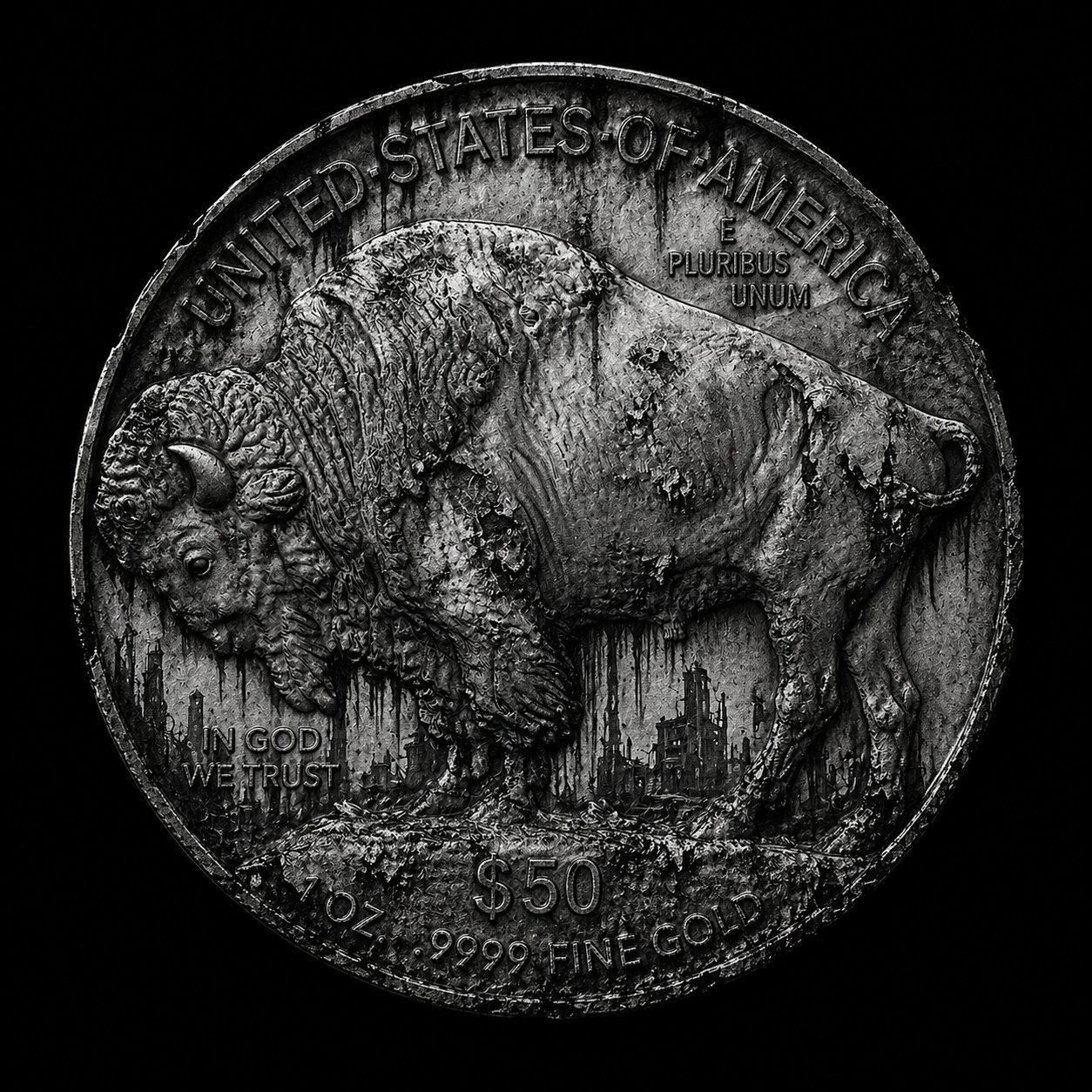
Somewhere around 2015, someone you know mentioned gold. Maybe it was your uncle at a family dinner, turning a Krugerrand over in his fingers like a poker chip. Maybe it was a colleague who wouldn't shut up about Gold Buffalos. Maybe it was a headline you skimmed while waiting for your coffee. Gold was around $1,160 an ounce. You thought about it. You didn't buy.
That thought has a price. Today, that same ounce trades above $4,800. The single coin you almost bought would have returned over 300%. Not a tech stock. Not a lucky crypto bet. A lump of metal that humans have agreed is valuable for roughly five thousand years.
But you're not here to read about gold's rally. You're here because you already know you missed it — and you've been quietly doing something far more expensive than missing a trade: you've been refusing to calculate exactly how much that miss cost you.
The number you won't run
Let's do it anyway. Ten gold coins — say, Krugerrands — purchased in 2015 at $1,160 per ounce plus a 5% dealer premium. Total outlay: roughly $12,180. The kind of money you spent on a vacation that year, or on a car repair you've already forgotten.
Those ten coins, sitting in a safe deposit box, doing absolutely nothing, would be worth approximately $48,000 today. A gain of $35,820. No rebalancing. No checking quotes. No panic selling during COVID. Just ten heavy circles in a drawer.
Now here's the question that matters: how does that number make you feel? If you're honest, it doesn't feel like information. It feels like an accusation. And that's exactly why you've never run it before.
Regret has a specific dollar value. For the person who considered ten Krugerrands in 2015 and didn't buy, it's $35,820. Not a metaphor. Not a life lesson. A number. Most people will go to extraordinary lengths to avoid seeing it.
The premium excuse
Here's what's particularly cruel about gold coins. They gave you a perfect reason not to buy them.
Physical gold carries a premium — 3% to 8% over the spot price, depending on the coin. Buffalos and Krugerrands on the lower end, some coins higher, but it's always there. And for anyone comparing options in 2015, that premium was an easy exit ramp. "Why would I pay $1,220 for something worth $1,160? I'll just buy a gold ETF instead." Reasonable. Rational, even.
Except you didn't buy the ETF either.
The premium wasn't the reason. It was the excuse. The reason was something murkier — some mix of "I'll do it next month," "gold seems boring," and "what if it drops?" The premium just gave that murkiness a respectable costume. You weren't avoiding a bad deal. You were avoiding a decision.
This is the anatomy of most investment regret. It's rarely a single catastrophic mistake. It's a small, reasonable-sounding objection that lets you postpone action until postponing becomes the action. A 5% premium became a 300% miss. Not because the math was wrong in 2015, but because the math was never the point.
Why gold makes regret worse
Stocks are abstract. You buy a ticker symbol, it lives in an app, and if it goes up or down, the whole experience is pixels on a screen. Easy to rationalize, easy to forget.
Gold coins are physical. They have weight. They have edges. Your uncle held one in his hand at that dinner in 2015 and you remember the way the light caught the springbok on the reverse. That's the problem — you can't abstract away the memory when the object has mass.
Psychologists call this the tangibility effect. We process concrete, physical objects more emotionally than abstract ones. A $35,000 gain on a screen is a number. A stack of ten coins you could have held, could have locked in a drawer, could have shown your kid — that's a story. And stories are where regret lives.
There's a second layer. Gold doesn't require skill. It doesn't require timing the market. It doesn't require reading earnings reports or understanding P/E ratios. You buy it. You hold it. That's it. Which means the regret isn't "I didn't know enough" — it's "I knew enough and I still didn't act." That's a much harder sentence to sit with.
The real cost is in the pattern, not the coin
Here's where most articles about gold would pivot to telling you to buy some. This isn't that article.
The coin doesn't matter. What matters is the pattern it reveals — because the same pattern is running right now, on a different asset, with a different reasonable-sounding excuse.
Think about it. Gold hit $1,060 at its 2015 low. Someone who was "waiting for it to drop below $1,000" never got in. Gold hit $2,000 in 2020. Someone who was "waiting for a pullback" watched it run to $4,000. Gold hit $5,595 in January 2026. Someone is right now saying "it's too expensive" — the same sentence people said at $1,200, at $1,800, at $3,000.
The excuse evolves. The behavior doesn't. And the cost compounds.
This is the part that should scare you more than any single missed trade: regret doesn't just have a price — it has a compound interest rate. Every year you repeat the same avoidance pattern, the gap between your real portfolio and the one you could have built gets exponentially wider. The 2015 miss is $35,000. The 2015-through-2026 pattern of systematic hesitation? That's your retirement.
What actually helps
Telling yourself to "be more decisive" is useless advice. You've tried that. It lasted until the next moment of genuine uncertainty, and then the old pattern took over. Here's something that might actually work:
Price your hesitation in real time. The next time you seriously consider an investment and feel yourself pulling back, write down exactly what you would buy, at what price, and the date. Don't buy it. Don't not buy it. Just write it down. Create a record of the decision you almost made.
Then set a calendar reminder for six months later. When it fires, look up the price. Run the math. See the number.
Do this five times and you will discover something uncomfortable: your "reasons" for not acting are rarely about the specific investment. They're about you. The same emotional flinch dressed up in different financial language. "The premium is too high." "The market feels toppy." "I want to research more." These are moods wearing the clothes of analysis.
The person who tracks this — who sees their own hesitation pattern laid bare in dollars — has something nobody else has: a map of the exact behavior that's costing them the most money. Not stock picks. Not macro calls. Behavior.
That map is worth more than any ten coins.
The weight of what you didn't hold
A one-ounce Gold Buffalo weighs 31.1 grams. It fits in your palm. It's warm after a few seconds of holding it.
The regret of not buying one weighs nothing. It takes up no space. You can carry it for a decade without anyone noticing — including yourself. That's what makes it so expensive. A loss you can see, you can fix. A loss you can't feel, you repeat.
Regret has a price. For most investors, it's the largest line item in their financial life — and the only one that never appears on any statement.
The question isn't whether you should have bought gold in 2015. It's whether you're doing the same thing right now, to a different asset, for the same reason, and calling it a different name.