Open last month's bank statement. You'll see where the money went: a coffee on the way in, two delivery orders on Friday, a subscription you meant to cancel back in March. The statement is honest about one thing and lies about another — it calls all of it "spent," when the money didn't actually disappear. It moved. Out of your future and into someone else's.
Every empty spend isn't a deduction. It's an investment somebody else made instead of you.
The $5 cup that costs $134,000
Take the most worn-out example there is — the one everyone's tired of joking about. A $5 coffee every working day. There are about 22 working days in a month, so call it $110 a month. The price on the receipt is five dollars. Hold onto that number.
Now the real price. Put that same $110 a month into a plain index fund returning roughly 7% a year after inflation, and in 30 years it becomes about $134,000 — and that's already in today's dollars, stripped of inflation. Total you actually put in: $39,600. Time did the rest.
The cup cost $5. The habit of drinking it on autopilot for thirty years cost $134,000.
This isn't about coffee. Coffee is innocent. It's that the price tag lies, systematically. It tells you the cost of parting with your money and says nothing about what that money could have become. The true cost of any purchase isn't the number on the receipt. It's the number it will never grow into.
The same cup — except now you keep the markup
Compare two ways of drinking the exact same coffee.
The first: a cup to go, $5, every weekday, for the rest of your life. The second: a Bialetti Moka Express — the iconic Italian stovetop pot that, by some estimates, brews around 120 million cups a day around the world. It costs about $30–40 once (depending on size) and lasts literally decades; people hand their aluminum mokas down to their kids. Ground coffee at home is cents per cup — maybe $10–15 a month.
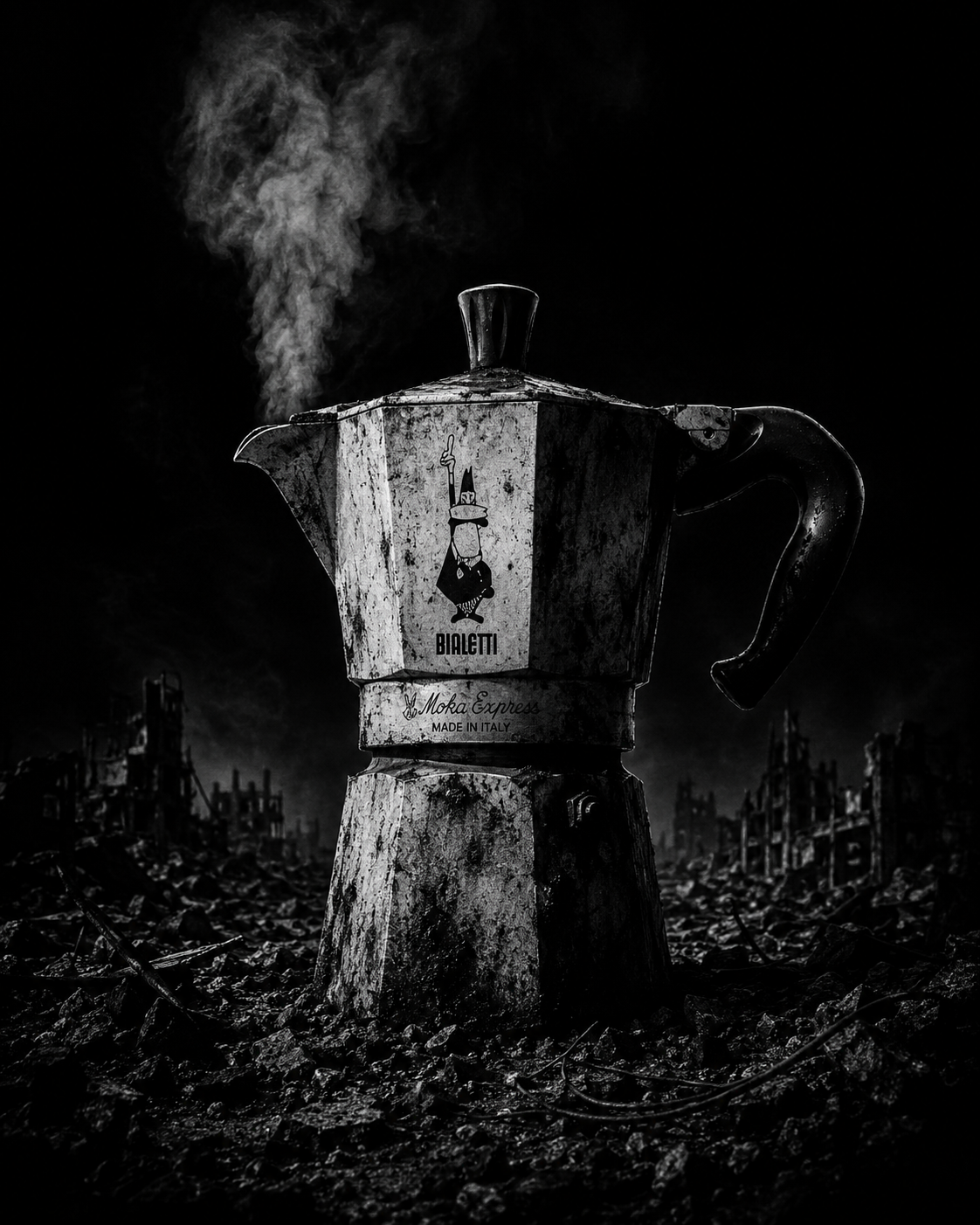
The gap between the two is almost $100 a month. And it isn't giving up coffee. It's giving up the markup.
You drink the same espresso. You're just the one pocketing the difference between the price tag and the cost — instead of the café on the corner. That ~$100 a month at the same 7% is about $122,000 over thirty years. A $35 coffee maker doesn't pay for itself in months. It pays for itself in a whole portfolio.
Here's the trick: it was never about drinking less. It's about who pockets the gap between the price and the cost.
Why we don't see it
The brain is excellent at noticing money leave. Five dollars off the card — a small sting, forgotten instantly. But the brain is physically incapable of noticing the $134,000 that never arrived. You can't miss something you never held.
So the expense tracking most people do counts only half the equation. You see the outflow. You don't see what it cost you.
And even the outflow is worse than it looks. C+R Research found that people estimate their subscription spending at about $86 a month. The real figure, once it's itemized, is $219. That's a $133 gap, every month, that people spend and genuinely don't notice. 89% underestimate this line. 42% admitted they'd forgotten about a subscription they're still paying for.
This isn't bad luck or personal sloppiness. The payment system is engineered to make paying invisible — small amounts, different dates, auto-renewal scattered across three cards. And "pay without noticing" and "forget without noticing" are the same button.
You're not a spendthrift. You're just keeping careful books on one side of the trade.
The most expensive part isn't the spend
Say you lose $134,000 to coffee over thirty years. Unpleasant, but it's a one-time figure. The real danger runs deeper, and it isn't about the size of the number.
The danger is that empty spends are invisible — and invisible losses repeat. A loss you can see, you eventually fix. A loss you can't feel, you repeat — every day, for years, without noticing.
And every repeat compounds on the last. This isn't one $134,000 miss. It's a habit that works like interest on a loan — except you issued the loan, to your own future, at someone else's rate.
Somewhere there's a version of your portfolio built entirely from money you spent on autopilot. It grows in silence. You never opened it, never funded it on purpose, never once saw its balance. But it's exactly as real as every small "ah, it's nothing" that built it.
That's the cost of what you didn't do. For most people it's the largest line item in their entire financial life — and the only one that shows up on no statement anywhere.
Why "spend less" doesn't work
The standard advice here is to tighten your belt. It's useless, for two reasons.
First, ordinary expense tracking only shows the past. "You spent $340 on restaurants" is a diagnosis with no prescription. You've learned you're sick; you haven't learned what to do. Most budgeting apps stop right there — at a tidy chart of your regret.
Second, austerity doesn't hold. You can cut everything that brings you joy for a month, maybe two. Then the old pattern comes back with interest. The point isn't to stop living. The point is to stop feeding a future you never chose.
What to actually do
Don't cut. Redirect.
When you catch an empty spend, don't just delete it — deleted money dissolves into other small things and you'll never notice it again. It has to move somewhere else immediately. And the key, non-obvious move is to automate that transfer so it doesn't depend on your willpower.
A concrete five-minutes-a-month protocol: once a month, find your empty spends — forgotten subscriptions, impulse buys, anything that gave you nothing. Don't cut everything. Cut only what left you no better off. The exact amount you cut, move into an index fund that same day — as an automatic rule, not a "someday." And give it a name.
That same $133 a month of forgotten subscriptions is about $162,000 in thirty years. Not $133 "saved." $133 built.
You already saw the clearest example of this move at the top — the coffee maker instead of the cup to go. Buy it once, and from then on you redirect the markup every month instead of paying it. And honestly — look — coffee from a moka is even better: thick, real, with that little gurgle on the stove in the morning instead of a paper cup on the run. Same habit, same warm morning ritual — except now it works for you instead of against you. Come on — that's just the better life.
Now the real twist, in the mechanics themselves. Keep two ledgers, not one. The first — where the money went; you already keep that. The second — where you redirected it, and what it's growing into. The second ledger makes visible what used to be invisible: the price of your decisions over time. Until you can see the cost of what you didn't do, you'll keep paying it, calling it a new name each time — "it's nothing," "I earned it," "just this once."
You're looking in the wrong place
Expense tracking answers the question "where did the money go." It's the wrong question — because the answer changes nothing anymore.
The right question: "who could that money have made me."
A cup of coffee costs $5. The habit of never noticing what it turns into costs a whole portfolio you never opened. You're not losing money on empty spends. You're faithfully funding a future you're not in.